The Rahmi M. Koc Museum is Turkey’s first and only industrial museum, occupying around 27,000 square metres on the north shore of the Golden Horn at Hasköy. It opened in 1994 in a restored Ottoman anchor foundry and expanded in 2001 into a nineteenth century dockyard next door, and it holds everything from a Second World War submarine you can walk through to a fourteenth century celestial globe.
It is also the building the boat passes on the outbound leg of the Golden Horn cruise route, with the audio commentary covering it as landmark five, about twenty minutes out of Karakoy.
What it is and where it came from
The museum was founded by Rahmi M. Koc through his museology and cultural foundation, dedicated to the history of industry, communication and transport. It was the first institution in Turkey to take that subject seriously as a museum rather than as a technical archive.
It occupies two historic buildings and an open air display area between them.
The Lengerhane. An Ottoman foundry that cast anchors and chains for the naval dockyard, the name coming from lenger, meaning anchor. It was built in the reign of Ahmed III between 1703 and 1730, on the foundations of an earlier Byzantine structure. It later served the state tobacco monopoly. The foundation bought it in 1991, restored it over two and a half years and opened it as the first section of the museum in 1994.
The Hasköy Dockyard. Built in 1861 by Sirket-i Hayriye, the Ottoman company that ran the Bosphorus ferries, for maintaining and repairing its own ships. Bought by the foundation in 1996, restored to its original condition and opened as part of the museum in 2001.
So the building housing a collection of industrial machinery is itself a piece of industrial heritage, twice over, and one of those layers sits on Byzantine foundations. That is the argument for coming here rather than to a purpose built museum.
What is in the collection
The museum divides its holdings into ten sections. These are the ones worth planning around.
Maritime
The strongest section, and appropriate given where you are standing. Full size boats and yachts alongside models, a collection of outboard motors, and a Bosphorus excursion caique that the museum treats as one of its highlights.
Named vessels include Kismet, the sloop in which Sadun Boro completed the first Turkish circumnavigation, the taka Tekel 15, the salvage tug Vernicos Irini, the steam yacht Gonca, the yawl Uzaklar and the tugboat Liman 2.
The submarine
The TCG Ulucalireis is the single most photographed object here. It was built as the American Tench class submarine USS Thornback at Portsmouth Naval Shipyard in 1944, over 93 metres long and displacing more than 2,400 tons. It served in the Pacific in the Second World War, transferred to the Turkish Navy on 2 July 1971 and was renamed, served thirty years, and came to the museum in 2001.
Access to the interior is a separately ticketed extra with limited capacity, sold at the museum rather than online. The museum does not publish a price for it, so ask on arrival.
Rail transport
Rolling stock plus models and ephemera. The named pieces include the Imperial Coach of Sultan Abdulaziz, a carriage and winding engine from the Tunel funicular, the Mototren La Littorina, a Kadikoy to Moda tram, a horse drawn tram and a G10 locomotive with its tender.
Aviation
Split between the indoor building and the open air area. A Douglas DC-3 Dakota, an F-104 Starfighter, a B-24 Liberator, a De Havilland Vampire, a Dornier Do 28 Skyservant, a Bell Cobra helicopter and a model of the Wright brothers’ glider.
Living History
Recreated period shops and workshops, and the section that holds children longest. A bazaar, a carpenter’s workshop with lathes, a fishing port, an olive oil factory, a rowboat workshop, a motor repair shop, a ship’s bridge and a film set.
Road transport
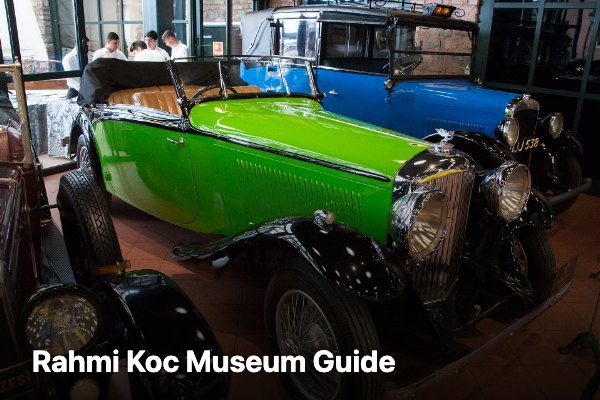
Horse carriages, hansom cabs, bicycles, motorcycles, agricultural vehicles, classic cars, fire engines and steam cars, covering road transport from the early nineteenth century onward.
Scientific and communication instruments
A fourteenth century celestial globe, a nineteenth century telescope, an orrery, time measurement instruments, and on the communication side telegraphs, telephones, phonographs, gramophones, cameras, a zoetrope and an Edison telegraph.
Models and toys
Handcrafted models from the eighteenth century onward. Most of the toys are in the main building and the dollhouses and miniatures are in the dockyard entrance hall.
Opening hours
| Day | Hours |
|---|---|
| Monday | Closed |
| Tuesday to Friday | 09:30 to 17:30 |
| Saturday and Sunday | 10:00 to 19:00 |
Last tickets are sold thirty minutes before closing. The museum also closes on the eve and first day of the two religious holidays, and on 31 December and 1 January.
One thing to be aware of. The museum’s own English homepage header and its hours page currently disagree about the weekday closing time, showing 17:00 in one place and 17:30 in the other. The hours page is the authoritative one, but if you are cutting it fine on a Friday afternoon, aim for the earlier figure.
Tickets
The museum sells tickets on site and through its own online channel. Prices are published on its hours and prices page, and there is currently a discrepancy between the figures shown on the English and Turkish versions of that page, so it is worth checking directly rather than relying on a quoted number. Third party sites are consistently out of date on this.
Two things are clear. There is a reduced student rate and a student group rate for parties of ten or more. And the Museum Pass Istanbul does not include this museum, since it is a privately run foundation museum rather than a state one, and the pass covers Ministry of Culture sites.
The museum also runs its own boat tours on the Golden Horn at a separate charge, adult and student rates, operating subject to weather.
How to get there
The museum publishes three routes.
By ferry. Hasköy pier, which sits roughly 120 to 150 metres from the entrance, effectively a two minute walk. It is a stop on the scheduled Uskudar to Golden Horn line, whose piers run Uskudar, Karakoy, Kasimpasa, Fener, Balat, Hasköy, Ayvansaray, Sutluce and Eyupsultan. Services are roughly hourly and the full run takes about 55 minutes.
By bus. The Kirmizi Minare stop.
By metrobus. The Halicioglu stop.
Paid and limited parking is available on site if you are driving.
The ferry is the obvious choice, and it is worth saying why. The museum is about industrial and maritime history on the Golden Horn, and arriving at it by boat along that same waterway is the correct approach to the subject. It also avoids the road route through Hasköy, which is slow.
Seeing it from the Golden Horn cruise
The cruise passes the museum on the outbound leg up the north shore, between the historic shipyard at Tersane Istanbul and the Golden Horn Bridge, with audio commentary in Turkish and English.
It is worth being clear about what that gives you. The cruise does not stop here. Its single stop is at Miniaturk further up the same shore, and the museum is a landmark you pass rather than a call.
What you see from the water is the waterfront of the dockyard section, the vessels moored along it including the ferry that now serves as a cafe, and the open air display area behind. It is a good introduction and an argument for coming back on a separate day, which is the honest way to use it.
The full route and the other nineteen landmarks are set out on the route and stops page.
How long to allow and who it suits
The museum publishes no official visit duration. Given 27,000 square metres across three areas and five catering outlets, a half day is realistic and two hours is the minimum that makes the trip worthwhile.
It suits children particularly well. The museum maintains dedicated pages for family, school and group visits, runs birthday parties and museum education programmes, and has a carousel and playground on site. Climbing into vehicles and walking through a submarine is a different proposition from looking at objects in cases.
It is indoor and outdoor. The main building and the dockyard are enclosed, and there is an open air display area between them. In January that matters, and in August the outdoor sections are exposed.
Eating on site is straightforward. Five outlets, including a cafe aboard a 1952 Istanbul ferry moored at the museum, a restaurant open until 22:00, a cafe in a converted vintage truck and two others. Most close on Mondays with the museum.
Accessibility is not published. The museum’s facilities page covers transport but makes no accessibility statement, so if step free access matters, contact them before travelling rather than assuming.
Combining it with the rest of the Golden Horn
The Uskudar to Golden Horn ferry line makes a chain of stops that work as a single day.
Fener and Balat on the south shore, two piers before Hasköy, with the colour washed houses, the Greek Orthodox Patriarchate and the cast iron Bulgarian church. Covered on the Balat and Fener page.
Miniaturk at Sutluce, further up the north shore, with 138 models of Turkish monuments at 1 to 25 scale. See the Miniaturk page.
Eyupsultan at the head of the waterway, with the mosque, the tomb complex and Pierre Loti Hill above.
A ferry hopping day along that line, with the museum as the long stop, is one of the better uses of a spare day in Istanbul and costs a handful of transit fares. Background on the waterway itself is in the Golden Horn guide.
Frequently asked questions
Where is the Rahmi Koc Museum?
At Rahmi M. Koc Caddesi 3 in Hasköy, on the north shore of the Golden Horn in the Beyoglu district. The nearest ferry pier is Hasköy, about two minutes on foot, on the scheduled Uskudar to Golden Horn line.
How much does the Rahmi Koc Museum cost?
The museum publishes its rates on its own hours and prices page, and the English and Turkish versions of that page currently show different figures, so check directly before travelling. There is a reduced student rate and a group rate for student parties of ten or more. Boat tours are charged separately.
Is the Museum Pass valid at the Rahmi Koc Museum?
No. It is a privately run foundation museum rather than a state one, and the Museum Pass Istanbul covers Ministry of Culture sites. Tickets are bought separately.
Can you go inside the submarine?
Yes, on a separately ticketed tour with limited capacity, sold at the museum. The TCG Ulucalireis was built as the USS Thornback in 1944, served in the Pacific, transferred to the Turkish Navy in 1971 and came to the museum in 2001. The museum does not publish a price for the tour, so ask at the desk.
Is the Rahmi Koc Museum good for children?
It is one of the better museums in Istanbul for children. There is a carousel and playground, recreated period workshops, vehicles and aircraft at close quarters, and dedicated family and school visit programmes. The mix of indoor and outdoor space also helps with restless children.
How long do you need at the Rahmi Koc Museum?
No official figure is published. With 27,000 square metres across two historic buildings and an open air area, allow a half day to see it properly and two hours as a minimum. Add time if you are doing the submarine tour or a boat trip.
Does the Golden Horn cruise stop at the museum?
No. The cruise passes it on the outbound leg with audio commentary, and its single stop is at Miniaturk further up the same shore. To visit the museum, take the ferry to Hasköy pier on a separate day.
What is the Lengerhane?
The Ottoman anchor foundry that houses the main museum building. It cast anchors and chains for the naval dockyard, was built in the reign of Ahmed III between 1703 and 1730 on Byzantine foundations, later served the tobacco monopoly, and was restored and opened as the museum in 1994.
Ready to cruise the Golden Horn?
Book your 2.5-hour Istanbul sightseeing cruise today