
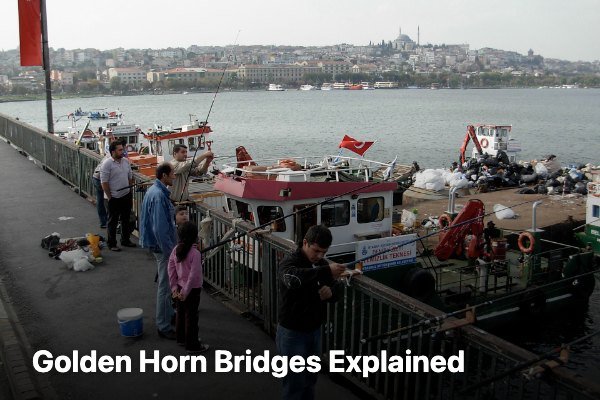
Four bridges cross the Golden Horn today. The Galata Bridge at the mouth, the Golden Horn Metro Bridge and the Atatürk Bridge in the middle, and the Halic motorway bridge upstream. At the Galata crossing alone, at least five successive bridges have stood since 1845, and Leonardo da Vinci once proposed a sixth that was never built.
The cruise passes under two of them, which makes the sequence worth knowing before you sail.
The four crossings today
| Bridge | Opened | Length | Carries |
|---|---|---|---|
| Galata Bridge | Traffic 1992, completed 1994 | 490 m | Road, T1 tram, pedestrians, restaurants below |
| Golden Horn Metro Bridge | 15 February 2014 | 936 m | M2 metro, pedestrian walkways |
| Atatürk Bridge | In service since 1940 | 453.5 m | Road, pedestrians |
| Halic Bridge | 10 September 1974 | 995 m | O-1 motorway only |
The Galata crossing, five bridges deep
The mouth of the Golden Horn is where the city has kept rebuilding, and each bridge tells you something about the era that put it there.
| Years | What stood there |
|---|---|
| 1845 to 1863 | A wooden pontoon bridge, commissioned by the mother of Sultan Abdulmecid I. Tolls were charged from 25 November 1845. |
| 1863 to 1875 | A second wooden pontoon bridge. Sources disagree over who commissioned it. |
| 1875 to 1912 | An iron pontoon bridge, 480 metres by 14, floating on 24 pontoons, built by a British firm after a French contract collapsed following the Franco-Prussian War. |
| 1912 to 1992 | The bridge most people picture, 466 metres by 25, in twelve floating sections with a movable 66.7 metre centre piece. Opened 14 April 1912. Electric trams ran over it from January 1914. |
| 1992 to now | The current bascule bridge, 490 metres by 42, built by a Turkish contractor. |
Two things to be careful about, because published accounts contradict each other. The German manufacturer of the 1912 bridge is disputed, with English and Turkish sources naming different firms while agreeing on the price of 350,000 gold lira and the dimensions. And the opening of the current bridge has two dates. The city’s own record says it took vehicle traffic on 17 June 1992, a month after the fire, construction having been accelerated. Most other sources say completed December 1994. Both are probably true of different milestones.
Tolls on the Galata crossing were finally abolished on 31 May 1930, after 85 years.
The fire, and where the old bridge went
The 1912 bridge burned on 16 May 1992, a Saturday, the fire breaking out around two in the afternoon in a restaurant on the Karakoy underside.
What happened next is a slow, unhappy story. The bridge was towed away about a week later and one damaged section collapsed during the tow. Classified as second degree cultural heritage, repaired sections were re-erected between Ayvansaray and Hasköy in 2002 and worked as a real crossing for a decade. It even reopened to cars between July and October 2012 while the motorway bridge upstream was being renovated.
Then it came apart again. In 2012 the middle section was towed to the shoreline because it was blocking water circulation and ferry passage. In December 2016 most of the remainder was moved to the Halic and Tuzla shipyards, and three sections went missing after towing, with roughly 74 metres unaccounted for.
Today it is dispersed and derelict. One piece sits on a corner in Balat, the rest in shipyards. There is no current restoration or display plan on record.
The current Galata Bridge, and how it opens
This is the one everybody photographs, and the engineering is more interesting than the fishermen suggest.
It runs 490 metres by 42, resting on 114 steel piles two metres in diameter, with two decks. It is a bascule bridge with four steel leaves, each weighing around 1,500 tonnes, two seated on the Eminonu caisson and two on the Karakoy caisson. Each caisson weighs about 30,000 tonnes. The leaves lift to 84 degrees in three and a half minutes, opening an 80 metre clear span. The city claims these are currently the largest bascule leaves of their kind anywhere.
Closed, the bridge gives six metres of clearance above the water, which is why it has to open at all.
It opens between 02:30 and 03:30, once a week from June to August and twice a week the rest of the year, plus one monthly closure for maintenance. So unless you are out very late you will not see it.
The lower deck holds around 6,500 square metres of restaurants and shops, added in 2003 in imitation of the ramshackle ones that clung to the 1912 bridge. The T1 tram has crossed the bridge since 30 January 2005, which is two decades after the bridge itself but well within most visitors’ assumptions.
The fishermen on the upper deck long predate the current structure and nobody counts them.
The Atatürk Bridge, and the crossing that came first
Upstream at Unkapani sits a crossing that is actually older than Galata. Four bridges have stood here.
The first, the Hayratiye, opened on 3 September 1836, commissioned by Mahmud II and built with naval arsenal labour from Kasimpasa on linked pontoons. Mahmud II rode across at the opening. It is the reason the 1845 Galata bridge was called the new bridge, because this one was the old one. Its length is disputed between sources by more than a hundred metres, so it is better left unstated.
An iron bridge built by a French company replaced it from 1875 to 1912, at 480 metres by 18. Then, in a neat piece of Ottoman thrift, the 1875 Galata Bridge was towed upstream and re-erected here in 1912, serving until a storm damaged it in 1936.
The current bridge has been in service since 1940. It was named for Mustafa Kemal by parliamentary decision in April 1930, before it was built. It runs 453.5 metres by 25, resting on 24 floating pontoons, and it opens to marine traffic on the same overnight schedule as the Galata Bridge. Its Unkapani approach was rebuilt in 2022 to let the T5 tram extend toward Eminonu.
The Halic Bridge, which you will not walk on
The motorway crossing between Ayvansaray and Halicioglu carries the O-1 inner beltway. It was built between 1971 and 1974 and entered service on 10 September 1974, engineered by a Japanese and German partnership.
At 995 metres long, 32 metres wide and 22 metres above the water, it is the longest and highest of the four, and the only one with no pedestrian or rail function at all. From the water it reads as infrastructure rather than architecture, which is exactly what it is.
The Metro Bridge, and the argument that surrounded it
The cable stayed bridge carrying the M2 metro between Azapkapi and Unkapani is the newest crossing and by some distance the most contested.
Construction began on 2 January 2009, the structure was finished on 9 January 2013, and it entered service on 15 February 2014 at a cost of 146.7 million euros. The conceptual design came from a French engineer, with Turkish architecture and construction supervision, built by an Italian and Turkish partnership. The towers are shaped as horns and the platform supports as hulls.
It runs 936 metres in total with 460 over water, a longest span of 180 metres between towers, a deck 12.6 metres wide sitting 13 metres above the water, and two walkways of 4.4 metres each flanking the tracks. A 120 metre swing section on the Unkapani side gives about 40 metres of clearance for ships, opening in four to six minutes. A station platform sits mid span under a canopy, which means you can get off a metro train in the middle of the Golden Horn.
The dispute was about the skyline. The idea of a metro crossing here dates to 1952, and 21 designs were submitted by 2005 without satisfying the monument protection board. When construction began, UNESCO objected that the towers would intrude on the historic peninsula’s silhouette, and the design was cut down repeatedly. Tower height and cable heights were reduced in stages and the station was shortened.
The figures reported for those reductions differ between sources, so they are best left approximate. What is unambiguous is the World Heritage Committee’s 2012 decision, which considered that the bridge as then being constructed would have an overall negative impact on the site’s outstanding universal value, and noted that with 85 percent of components already manufactured no further structural change was possible. The only mitigation left was colour, lighting, noise and landscaping.
The dispute was never resolved so much as dropped. Istanbul was never placed on the List of World Heritage in Danger over the bridge, and the Committee’s most recent decision on Istanbul makes no mention of it at all, having moved on to other concerns. Meanwhile the Halic station and its walkways gave people without cars a way across the Golden Horn that had not existed before, and complaints have quietened.
What never got built
The earliest recorded bridge over the Golden Horn was built under Justinian I in the sixth century, near the land walls at the western end of the inlet. In 1453 the Ottomans lashed ships side by side to move troops across.
Then, in 1502, Leonardo da Vinci proposed a single span of 280 metres to Bayezid II, which would have been the longest bridge in the world. It was rejected. Michelangelo was invited to try and declined. A small scale version of Leonardo’s design was eventually built near Oslo in 2001, five hundred years late and in the wrong country.
There is no dedicated footbridge over the Golden Horn. Pedestrians cross on the Galata Bridge, the Atatürk Bridge, or the walkways of the Metro Bridge.
Seeing them from the water
The cruise passes under the Atatürk Bridge and the Golden Horn Bridge on the outbound leg up the north shore, which is the stretch where the waterway narrows and the bridges come at you in sequence. The full landmark order is set out on the route and stops page.
What to look for from the deck. The bascule leaves on the Galata Bridge are visible as the joints in the road surface near the centre. The Metro Bridge’s swing section sits on the Unkapani side rather than mid channel. The Atatürk Bridge is the low one on pontoons, sitting almost at water level, which is why it also has to open. And the motorway bridge upstream is the one high enough that nothing has to move at all.
Background on the waterway they cross is in the Golden Horn guide.
Frequently asked questions
How many bridges cross the Golden Horn?
Four. The Galata Bridge at the mouth, the Golden Horn Metro Bridge and the Atatürk Bridge in the middle stretch, and the Halic Bridge carrying the motorway upstream. There is no separate footbridge.
When was the Galata Bridge built?
The current one carried its first traffic in June 1992 and was completed in 1994. It is the fifth bridge at that crossing since 1845, following wooden pontoon bridges in 1845 and 1863, an iron one in 1875, and the well known 1912 bridge that burned in May 1992.
Does the Galata Bridge open?
Yes. It is a bascule bridge with four leaves of around 1,500 tonnes each, lifting to 84 degrees in three and a half minutes to give an 80 metre clear span. It opens between 02:30 and 03:30, once weekly from June to August and twice weekly otherwise.
What happened to the old Galata Bridge?
It burned in May 1992, was towed away, and repaired sections were re-erected between Ayvansaray and Hasköy in 2002. It was moved again in 2012 and 2016, three sections went missing after towing, and today it is dispersed between a corner in Balat and two shipyards. There is no restoration plan on record.
Why was the Golden Horn Metro Bridge controversial?
Because of its visual impact on the historic peninsula’s skyline. UNESCO objected, the tower and cable heights were cut in stages, and the World Heritage Committee concluded in 2012 that the bridge as built would have an overall negative impact. Istanbul was never listed as in danger, and the issue has since disappeared from the Committee’s agenda.
Can you walk across the Golden Horn?
Yes, on three of the four bridges. The Galata Bridge and the Atatürk Bridge both take pedestrians, and the Metro Bridge has walkways 4.4 metres wide on either side of the tracks. Only the motorway bridge is closed to people on foot.
Which bridge does the metro cross?
The Golden Horn Metro Bridge, carrying the M2 line between Azapkapi and Unkapani. It opened on 15 February 2014 and has a station platform in the middle of the span, so you can get off a train over the water.
Did Leonardo da Vinci design a bridge for Istanbul?
He proposed one, in 1502, to Sultan Bayezid II. It was a single 280 metre span that would have been the longest bridge in the world at the time. The proposal was rejected, and a scale version was eventually built near Oslo in 2001.
Ready to cruise the Golden Horn?
Book your 2.5-hour Istanbul sightseeing cruise today