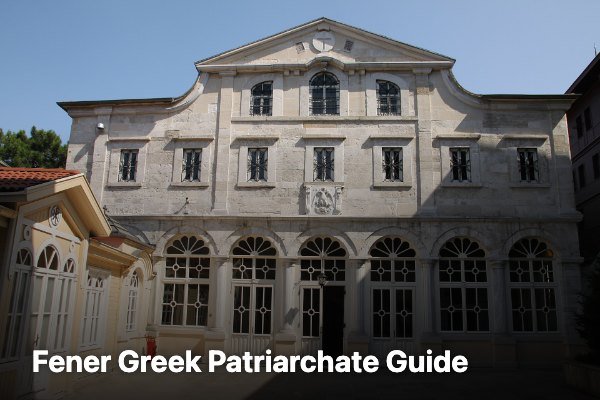
The Fener Greek Orthodox Patriarchate is the seat of the Ecumenical Patriarch of Constantinople, first among equals in the Eastern Orthodox Church, and it has stood on this walled compound above the Golden Horn since 1600. Its Patriarchal Church of St George is a working church rather than a museum, small, dark and dense with relics, and it is free to enter.
The compound’s main gate faces the Golden Horn, which is not an accident, and it is the reason this sight belongs in a boat trip along the waterway as much as in a walk through Balat.
What the Patriarchate is
The Church traces its foundation to the Apostle Andrew, the First-Called, whose feast on 30 November is kept here as the Feast of the Throne. The Patriarch’s formal title, Archbishop of Constantinople-New Rome and Ecumenical Patriarch, dates to the sixth century.
The present holder is Patriarch Bartholomew, born on the island of Imbros in 1940 and a citizen of Turkey. He was elected in October 1991 and enthroned on 2 November that year as the 270th holder of the see. He studied at the Theological School of Halki, then in Rome, Bossey and Munich, and holds a doctorate in canon law from Athens. He is widely known as the Green Patriarch for his environmental work.
He is recognised as the spiritual leader of the world’s roughly 300 million Orthodox Christians. That is a primacy of honour across the Orthodox communion rather than direct jurisdiction over all of them, which is a distinction worth keeping straight.
The Patriarchate has always functioned canonically as a monastery, with the Patriarch as its abbot. The layout of the Fener compound, enclosed behind a high wall, still reflects that. Its own texts describe it as the first monastery of Orthodoxy, closed within its high enclosure.
Why it is here, and where it was before
The Patriarchate has moved repeatedly, and each move was forced.
| Period | Seat |
|---|---|
| Early Byzantine | Beside Hagia Eirene, then adjoining Hagia Sophia |
| 1204 to 1261 | Relocated to Nicaea after the Fourth Crusade |
| 1261 to 1453 | Hagia Sophia again |
| 1453 to 1456 | The Church of the Holy Apostles, granted by Mehmed II |
| 1456 to 1587 | The Pammakaristos convent, until it was converted to a mosque |
| 1587 to 1597 | The houses of the Wallachians, with a temporary patriarchal church |
| 1597 to 1600 | St Demetrios of Xyloporta |
| 1600 to present | St George in the Fener |
After the conquest of 1453, Mehmed II recognised the Patriarch as head of the Rum millet and granted the new Patriarch Gennadios Scholarios the imperial Church of the Holy Apostles as a seat. Three years later that was exchanged for the Pammakaristos convent on the fifth hill, which Murad III converted into a mosque in 1587 to commemorate a campaign. Two more temporary seats followed before the Patriarchate obtained permission in 1600 to repair a building at Fener, where it has remained for four centuries.
The Church of St George
A small church was already on the site when the Patriarchate arrived, by tradition the katholikon of a women’s monastery. It was rebuilt and enlarged in 1614 by Patriarch Timothy, by order of Sultan Ahmed I, using the master builder and craftsmen who were at that moment building the sultan’s own mosque at the Hippodrome.
Fire destroyed it in the early eighteenth century. Patriarch Jeremias III rebuilt it larger, and that is the three aisled basilica standing today, dated by a narthex inscription to 18 December 1720. Patriarch Gregory VI raised the roof to its present height in the 1830s, and the central marble portal with its carved neoclassical lintel dates from that 1836 work.
The plan is a three aisled basilica with three semicircular apses at the east end and a transverse narthex at the west. The central nave is deliberately spacious to allow liturgical processions, and there is a women’s gallery to the west.
What to look for inside
The patriarchal throne. Tradition associates it with St John Chrysostom, but the Patriarchate’s own account places it under Patriarch Jeremias II the Great in the late sixteenth century, made for the Pammakaristos and moved here with the Patriarchate. Walnut inlaid with ivory, mother of pearl, coloured wood and precious stones, about four metres tall under a canopy on two colonnettes. An ivory inscription on the canopy is dated 1577. Its original ornaments were looted in a raid on the church in 1680.
A living custom attaches to it. On the two feasts of St John Chrysostom, 13 November and 27 January, the saint’s icon and a patriarchal crosier are placed on the throne and the Patriarch presides from the seat beside it instead.
The column of the flagellation. In the south aisle, in a carved gilded frame, a portion of the column at which Christ was bound and scourged by tradition. Other fragments are in Rome and Jerusalem. St Helena is held to have brought this one to Constantinople after her visit to the Holy Land.
The relics of Gregory the Theologian and John Chrysostom. Two carved alabaster reliquaries in the north aisle, which forms the chapel of the Three Hierarchs. Gregory’s relics were taken to Rome in the eighth century by iconophiles fleeing Iconoclasm. Chrysostom’s were seized by the Crusaders in 1204. Both were returned to the Patriarchate by Pope John Paul II in November 2004 and carried from the Vatican to Istanbul. Eight hundred years for one of them, and they came back within living memory.
Three women saints in the south aisle. St Euphemia, patron of Chalcedon, St Solomone, mother of the seven Maccabees, and St Theophano, first wife of Emperor Leo VI. The cypress for their reliquaries was donated by the Russian ambassador on 11 July 1707.
The mosaic icons. The Panagia Pammakaristos, of the Hodegetria type, dated on stylistic grounds to the mid eleventh century, is the palladium of the monastery that housed the Patriarchate from 1456 to 1587, saved when the building became a mosque. Beside it, a mosaic of St John the Forerunner from roughly the same date and possibly the same workshop. In the north aisle, an icon of the Panagia of Kyzikos from the Komnenian period with its faces almost entirely destroyed, and a Palaiologan Christ Pantokrator.
The iconostasis. Tall, gilded and fully carved, with a double headed eagle on the Holy Doors, the emblem of the Patriarchate. The main icons are dated 1746 and signed by Konstantinos of Adrianople.
The ambo of 1703, walnut inlaid with mother of pearl, and chanters’ stalls brought from the Kamariotissa monastery on Halki in 1712.
The gate that has not opened since 1821
The compound’s central entrance faces the Golden Horn and preserves the form of a fortified monastic gateway. It has three gates, and the one normally used is the left hand one.
The central gate has stayed shut since 10 April 1821, Easter Sunday, when Patriarch Gregory V was hanged from it by the authorities of the day in the aftermath of the Greek uprising. His body was afterwards thrown into the sea. The gate was never reopened, and since then every Patriarch has used the side entrance instead.
The Patriarchate’s own text on the gate invites the visitor to stand there silently for a moment, which is the most useful instruction anyone can give you about the place.
Two notes on the date. 10 April 1821 is the Old Style date the Patriarchate itself uses, corresponding to 22 April in the Gregorian calendar, and both appear in print. And the gate is often described as welded shut, which is a travel writing convention rather than something the Patriarchate says. Its own wording is only that the gate remains closed and never reopened.
Visiting
The Patriarchate publishes its schedule of divine services but no separate visitor timetable, so the practical guidance below is what visitors report rather than an official statement.
| Service | Time |
|---|---|
| Orthros, Monday to Saturday | 08:00 |
| Orthros, Sunday and feast days | 08:00 |
| Divine Liturgy, Sunday and feast days | 09:30 |
| Vespers, Monday to Friday | 16:30 |
| Vespers, Saturday, Sunday and feast days | 16:00 |
Entry is free. There is no ticket, and a donation box inside.
Hours. The church keeps normal daytime hours, generally reported as roughly 08:30 to 16:00, though the Patriarchate publishes no visiting timetable of its own. If you are travelling specifically for it, allow flexibility.
Non Orthodox visitors are welcome. The compound receives pilgrims, heads of state and tourists routinely.
Dress modestly. Shoulders and knees covered, as at Istanbul’s mosques. This is not a published rule but it is the expectation.
Treat it as a working church. Photography inside is widely reported as restricted, and the sensible approach is to ask rather than assume. Do not photograph people at prayer.
Busiest times are Sunday mornings during the Liturgy and the major feasts, which here means 30 November for St Andrew, 1 September for the Indiction, 11 July and 16 September for St Euphemia, 13 November and 27 January for St John Chrysostom, and Easter.
Getting there
The address is Dr. Sadik Ahmet Caddesi 19, in the Fener quarter of the Fatih district, on the south shore of the Golden Horn.
By ferry. Fener pier, on the scheduled Uskudar to Golden Horn line, roughly 300 metres and four or five minutes on foot, slightly uphill away from the waterfront. Balat pier is the next one along, about 700 metres north.
By tram. The T5 line runs along the Golden Horn shore from Eminonu toward Alibeykoy and serves Fener and Balat.
The ferry is the better arrival. The compound’s main gate was built facing the water because that is how people came, and approaching it along the Golden Horn is the way the building was meant to be reached.
What else is close by
Fener and Balat run into each other along the shore and both are worth the walk.
The Phanar Greek Orthodox College, the enormous red brick building on the hill directly above the Patriarchate, is the most visible landmark in Fener from the water and is frequently mistaken for the Patriarchate itself. It is a school, founded in 1454, and the current building dates from 1881.
The Church of St Stephen of the Bulgarians sits on the waterfront a few minutes north, cast in iron in Vienna, shipped down the Danube and across the Black Sea, and assembled here in 1898.
Balat’s painted houses, along Vodina Caddesi and Kiremit Caddesi, are the photographs everyone comes for.
All of it is covered on the Balat and Fener page.
Seeing it from the Golden Horn
The Patriarchate appears on the return leg of the cruise route, coming back down the south shore, as landmark sixteen, with audio commentary in Turkish and English.
Be clear about what that gives you. The cruise passes rather than docks, and its single stop is at Miniaturk on the north shore. From the water you see the walled compound, the dome of St George behind the wall and the red brick college rising above it, which is enough to understand the geography and not enough to see the relics.
The sensible use of the cruise is as the overview, followed by a separate day walking Fener and Balat with the ferry as transport. Background on the waterway is in the Golden Horn guide.
Frequently asked questions
Can anyone visit the Fener Greek Patriarchate?
Yes. The Church of St George is open to visitors of any faith and there is no admission charge. It is a working church rather than a museum, so dress modestly, keep quiet and avoid photographing people at prayer.
Is there an entry fee?
No. Entry is free, with a donation box inside the church. No ticket system operates and the Museum Pass is not relevant, since this is not a state museum.
Why is the gate at the Patriarchate closed?
Patriarch Gregory V was hanged from the central gate on Easter Sunday 1821, in the aftermath of the Greek uprising. The gate has never been opened since, and every Patriarch has used the side entrance instead. The Patriarchate’s own account gives the date as 10 April 1821 in the Old Style calendar, which is 22 April in the Gregorian.
Who is the Ecumenical Patriarch?
Bartholomew, born on the island of Imbros in 1940 and a Turkish citizen. He was elected in October 1991 and enthroned that November as the 270th holder of the see, and is recognised as first among equals across the Orthodox world.
What relics are in the Church of St George?
The relics of Gregory the Theologian and John Chrysostom, in alabaster reliquaries in the north aisle, returned by Pope John Paul II in November 2004 after eight centuries in Rome. Also a portion of the column of the flagellation, and the reliquaries of St Euphemia, St Solomone and St Theophano in the south aisle.
How long does a visit take?
The church is a single building with a narthex, three aisles and a courtyard, so half an hour covers it comfortably. Combining it with a walk through Fener and Balat makes a half day.
What is the red brick building above the Patriarchate?
The Phanar Greek Orthodox College, a school founded in 1454 whose present building dates from 1881. It is the most prominent landmark in Fener seen from the water and is often mistaken for the Patriarchate, which sits below it behind a wall.
Does the Golden Horn cruise stop at the Patriarchate?
No. It passes on the return leg with audio commentary, and its single stop is at Miniaturk on the opposite shore. To go inside, take the ferry to Fener pier, about five minutes’ walk away, on a separate visit.
Ready to cruise the Golden Horn?
Book your 2.5-hour Istanbul sightseeing cruise today